Download Genome: The Autobiography Of A Species In 23 Chapters (P.S.)
Book, the true pal of your own while being in a lonely time. Book, is a friend for you to go along with when remaining in a difficult time of job due date. Publication is a way that you should hold day-to-day to earn far better future. When somebody is leading to get lots of activities and also you have few times freely, it will be much better for you to spend it wisely.
Genome: The Autobiography Of A Species In 23 Chapters (P.S.)

Download Genome: The Autobiography Of A Species In 23 Chapters (P.S.)
Ended with your leisure and also have no concept how you can do? Get the Genome: The Autobiography Of A Species In 23 Chapters (P.S.) as well as take it as your reading book. Why should read? Some people will certainly assume that this is an extremely careless and also boring task to do. Moreover, lots of with spare time usually think that they are totally free. That's not the time for knowing. Well, reads only for your when discovering or researching something? Absolutely that's not.
Spare time comes to be a very valuable time for lots of people. This is the time to lose all exhausted, worn down, and also tired jobs or responsibilities. However, having also long time will make you feel bored. Additionally, you will really feel that so when you have no activities. To deal with the tiny problem, we show a publication Genome: The Autobiography Of A Species In 23 Chapters (P.S.) that can be a means to accompany you while being in the spare time. It can be reading product, not as the cushion naturally.
By seeing this page, you have done the ideal gazing point. This is your beginning to select the publication Genome: The Autobiography Of A Species In 23 Chapters (P.S.) that you desire. There are great deals of referred books to review. When you wish to get this Genome: The Autobiography Of A Species In 23 Chapters (P.S.) as your publication reading, you could click the web link page to download and install Genome: The Autobiography Of A Species In 23 Chapters (P.S.) In few time, you have possessed your referred e-books as all yours.
The referred publication with the straightforward writing style, very easy to keep in mind and recognize, as well as offered in this website ends up being the minimally benefits to take. In the good way, providing the expertise for others will certainly make you much better. In addition, when you likewise take pleasure in reading this Genome: The Autobiography Of A Species In 23 Chapters (P.S.) as one of the sources to accumulate, you can likewise discover the precise definition of this book.
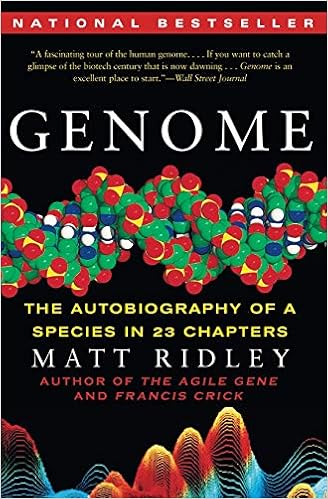
The genome's been mapped.But what does it mean? Arguably the most significant scientific discovery of the new century, the mapping of the twenty-three pairs of chromosomes that make up the human genome raises almost as many questions as it answers. Questions that will profoundly impact the way we think about disease, about longevity, and about free will. Questions that will affect the rest of your life. Genome offers extraordinary insight into the ramifications of this incredible breakthrough. By picking one newly discovered gene from each pair of chromosomes and telling its story, Matt Ridley recounts the history of our species and its ancestors from the dawn of life to the brink of future medicine. From Huntington's disease to cancer, from the applications of gene therapy to the horrors of eugenics, Matt Ridley probes the scientific, philosophical, and moral issues arising as a result of the mapping of the genome. It will help you understand what this scientific milestone means for you, for your children, and for humankind.
Your recently viewed items and featured recommendations
›
View or edit your browsing history
After viewing product detail pages, look here to find an easy way to navigate back to pages you are interested in.
Product details
Paperback: 368 pages
Publisher: Harper Perennial; Reprint edition (May 30, 2006)
Language: English
ISBN-10: 0060894083
ISBN-13: 978-0060894085
Product Dimensions:
5.3 x 0.8 x 8 inches
Shipping Weight: 9.6 ounces (View shipping rates and policies)
Average Customer Review:
4.4 out of 5 stars
345 customer reviews
Amazon Best Sellers Rank:
#113,224 in Books (See Top 100 in Books)
Was disappointed at the date of the book . Originally published in 1999 , then 2002 , then 2006 . At that age the book is barely relevant to today's fast pace . Amazon should go out it's way to specifically note the latest published date especially with tech books.Not a keeper
As a molecular biologist, I read it for perspective. I think the average person would be surprised by the science and the content. It is well written and well grounded in science
Although ostensibly about DNA and the human genome, it is actually more of a philosophical view of the human condition using a handful of genes as examples of the way us naked apes function, mentally, physically, emotionally, even socially. The book thankfully does not often get heavily into the deep scientific aspects of DNA research.For the most part, an entertaining book written in a generally engaging manner. As mentioned elsewhere, it is a bit uneven. Sometimes Mr. Ridley had to really reach to come up with a gene that he could write about, or enough to say about it to pad the article out to chapter length. Somewhere around chromosome 17 or 18, I don't know if he started running out of steam or I did. Don't try to read the whole thing continuously; take a few days off between chapters, you'll find it easier to maintain enthusiasm.
I bought this book as a text book for a class I was dreading. I am NOT a math or science person, but the subject matter is of interest. This book is a pleasant surprise. It dumbs down the material enough for us novices, but still is written intelligently where we have to reach a bit to understand it. I actually enjoyed most of the book and couple with my professor's teaching style, I learned and retained a lot more than I imagined. Would be a great book as an introduction for personal knowledge and growth, for math and science people as well as those of us who are not.
I would give the book 4.5 stars. With a Masters degree in molecular biology, I was able to understand all (well, nearly all) of the biological, evolutionary and genetic concepts introduced and discussed in the book. However, I surmise that someone without a degree/knowledge of biology, and in particular molecular genetics, some concepts in the book may be slightly difficult to understand fully.However, having said that, Matt Ridley is an outstanding writer. He makes dry topics sound interesting, stimulating and geniuinely exciting - all of which makes the book a page turner. He does a very good, albeit not flawless, job of explaining biological/genetic concepts for the laymen. However, I would recommend, especially for the laymen, to read slower in order to really understand what the author is saying. It's easy to understand the big picture, but to truly understand the topics/concepts the author discusses occasionally requires re-reading some passages and paying attention to details.The only complaint, is that despite Ridley's otherwise excellent explanations, it seems that at times he is in a hurry and glosses over some concepts, leaving the reader on his/her own to grasp the concepts. However, this does not happen too frequently in the book, and either way someone else may have a different interpretation from me.None of the above, I should note, should be taken as though Ridley's writing is difficult and/or technical. It absolutely is not. It is written in an easy prose, with very little technical jargon, which even when present, is explained fully. The occasional difficulty noted above, lies not with linguistics, but with biological/genetic concepts.Otherwise, I highly recommend for anyone!
Although I've read books about DNA before, this one had quite a few new surprises and insights in it. For instance, each time a cell duplicates itself (during embyology or in the process of everyday bodily upkeep), a cell copies its DNA, but fails to copy the first few letters of each DNA strand. Thus the strand gets a little shorter each time it is copied. Each chromosome is equipped with a "telomere", a several-thousand letter buffer zone on the ends which can be safely discarded. Thus, one of the limits to human life spans (or other animals for that matter) is the number of times a cell can be duplicated before it starts to lose meaningful DNA. The DNA of sex cells do not shorten when copied because of a repair enzyme known as telomerase. Perhaps immortality depends upon (among other things) using telomerase in other cells.Cells must be able to duplicate in order to repair damage due to daily wear and tear. But the duplication must be kept under strict control; cancer is the uncontrolled duplication of cells. Chemotherapy and radiation therapy work by damaging cell DNA, which triggers the body's own tumor-suppression genes to cause the tumor cells to self-destruct.I had never heard before that genes can be switched on and off in response to external events, and that give a whole new dynamic view to the genome. Ridley explains that most genes in most cells at any given time are "turned off". But, for example, the body makes cortisol in response to stress, and cortisol is made by switching on a gene that produces an enzyme to convert cholesterol into cortisol. He gives the impression that this is not some isolated case, but commonplace in everyday events. This leads to implications on free will vs. genetic determinism.Free willRidley gives the best description of free will I've ever heard: "If genes can affect behavior and behavior can affect genes, then the causality is circular. And in a system of circular feedbacks, hugely unpredictable results can follow from simple deterministic processes." This is an example of a chaotic system, like the weather. Tiny variations in input conditions soon yield enormous differences in output, and the weather is thus unpredictable in detail beyond a few days in advance (although we know general patterns, such as the fact that summer will be warmer than winter). "This interaction of genetic and external influences makes my behavior unpredictable, but not undetermined. In the gap between those words lies freedom."
Genome: The Autobiography Of A Species In 23 Chapters (P.S.) PDF
Genome: The Autobiography Of A Species In 23 Chapters (P.S.) EPub
Genome: The Autobiography Of A Species In 23 Chapters (P.S.) Doc
Genome: The Autobiography Of A Species In 23 Chapters (P.S.) iBooks
Genome: The Autobiography Of A Species In 23 Chapters (P.S.) rtf
Genome: The Autobiography Of A Species In 23 Chapters (P.S.) Mobipocket
Genome: The Autobiography Of A Species In 23 Chapters (P.S.) Kindle